“O holy mother mine, O thou firmament that dost revolve the common light of all, thou seest the wrongs I suffer!” — Aeschylus1
Any project of re-enchantment which focuses more on ancient errata, numinous myths, and undiscerned spirits than on the crucial link between heroic virtue and God’s own wisdom risks devolving into superstition and magical thinking like its predecessors in the Renaissance and the late Roman Empire. Near as I can tell, these virtues are what we gesture to by the vague phrase “western values,” a name from which they desperately need to be rescued.
Justice in particular was once heralded as the guide star of human civilization and the form of a life well lived. It still is the guiding light of human life, but it has become clouded by darkness in the modern day where we are no longer habituated to seeing justice as something noble. We do not love virtue like our predecessors did, and especially not cold justice which is used to invoke burdensome obligations against comfort and is so often put in tension with the cheerier (we imagine) traits of mercy and love. For us justice represents the cold unfeelingness which we perceive in the universe bound up in the steely shackles of a duty which, despite what Kant would have us believe, is not the same as love. Love represents what we would like for the universe to be, perhaps even what we believe it to be if we have faith. Some stanzas of Auden capture this attitude:
Looking up at the stars, I know quite well
That, for all they care, I can go to hell,
But on earth indifference is the least
We have to dread from man or beast.
How should we like it were stars to burn
With a passion for us we could not return?
If equal affection cannot be,
Let the more loving one be me.2
For the ancients however, though pagans placed the emphasis on justice and Christians on supernatural charity, there was no contradiction between love and justice. Or at least this is true of the mainstream wisdom tradition. The past of course is not monolithic. It too had its atheists and relativists who thought that the degree of suffering and chaos they perceived in the world meant that the gods were unjust, apathetic, or simply did not exist. But for many, even before Christ, the disconnect between cosmic chaos and the deepest desires of man’s heart only fortified their belief in transcendent good and hope that justice would one day be realized.
The classic case is Virgil’s Fourth Eclogue. For almost two thousand years this poem has popularly been interpreted as a prophecy of Jesus Christ’s incarnation and the reestablishment of justice by the Kingdom of God. Whether this reading was the fruit of Constantinian propaganda, Virgil using Jewish sources, genuine inspiration, or some combination of the above I cannot say. But that there would be seeds of the Gospel which prepared the Romans for conversion is no accident. This is what should be expected if Christ did appear, as the Apostle says, “in the fullness of time.”33 If nothing else it’s a poem resonant with the hopes of a messianic age, and it does display deeper parity with the Bible than might be expected. Virgil knew what his audience wanted to hear, and even now in translation the poem burns fervid with anticipation on unburnt pages for old things to be restored under the novel sign of a divine virgin.
It is the pair of phrases about the virgin which most immediately strikes Christian readers that there is something oracular in the poem which transcends pagan imagination: “Now the Virgin returns, the reign of Saturn returns.”4 So powerful was this allusion that Virgil, whose name in Latin is “Vergilius,” began to have his name spelled in the middle ages with the “e” traded for an “i” to make it a pun on “virgo.” The style of interpretation which looks for key phrases or images to make analogies to the Christian story is rather obvious: there is a virgin named in the eclogue and Christ’s mother was a virgin. But that read is too glib: a temptation for Christian interpreters to think less carefully about why the ancient verse would speak so powerfully as to help make old Romans become new Christians. Even if Virgil had used Isaiah as a source for his poem as some scholars suggest, the details do not quite coincide. Isaiah writes, “The Lord himself shall give you a sign; behold, a virgin shall conceive, and bear a son, and shall call his name Immanuel.”5 In Virgil’s verse, however, the virgin is not in the act of conceiving; she is returning from somewhere. She was here but now she is not. Someone might suggest that instead this is an astrological sign. Perhaps the virgin’s return is paired with Saturn’s reign because when the miraculous child Virgil foretells is born, Saturn will be in Virgo: the child could be due late summer. But even this is at best incomplete and would do little for ancient Christians who had already begun to celebrate Christmas in December. Besides, Virgil does not say that the Virgin returns to heaven as the sun visits her in late summer as one would expect if he intended an exclusively astrological read. Rather, the Virgin returns to earth.
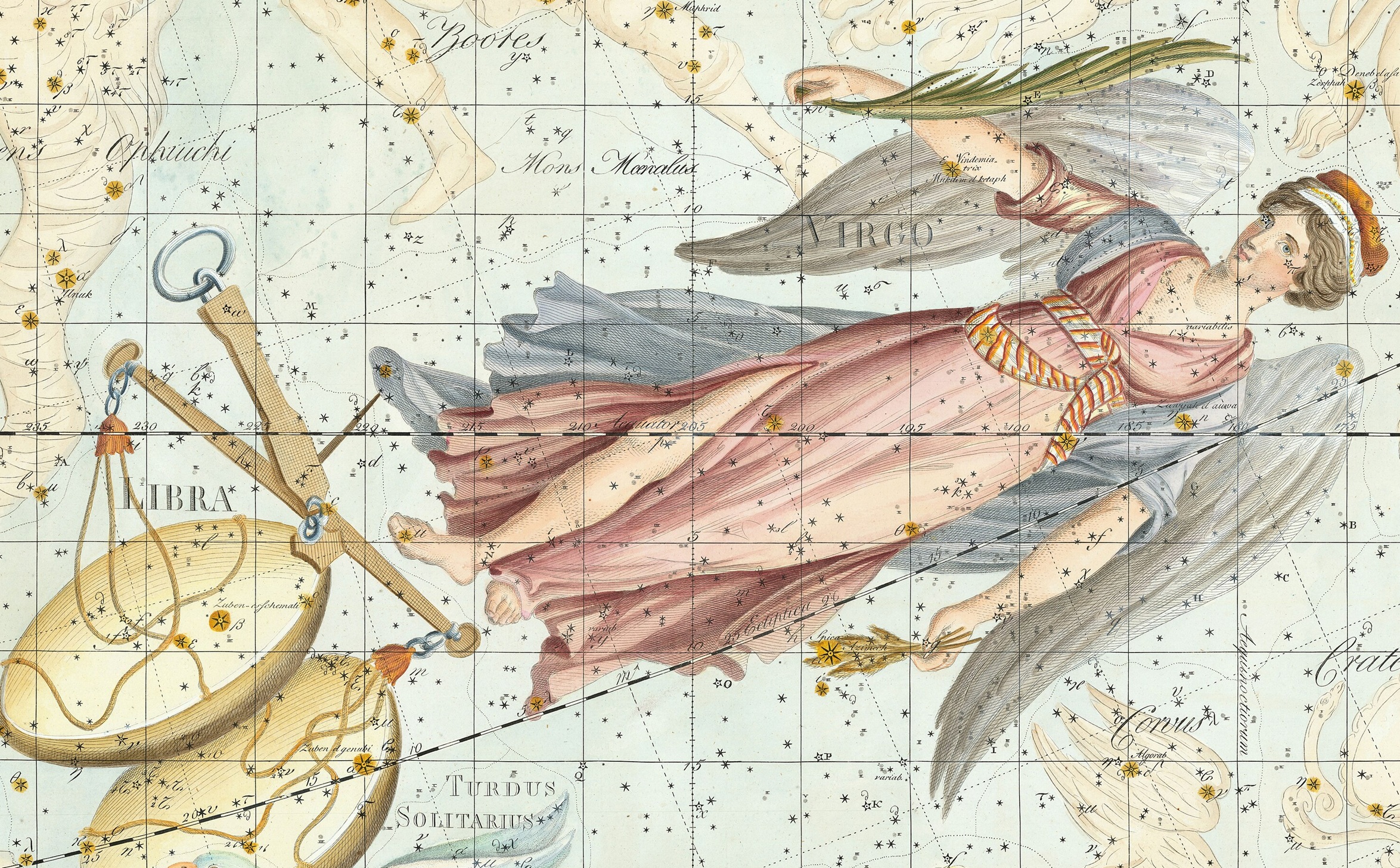
In ancient times the constellation Virgo was often identified with Astraea, goddess of justice, and the neighboring constellation Libra as her scales. According to the accounts in Hesiod’s Works and Days and Ovid’s Metamorphoses, Astraea lived among men when Saturn (Cronus to the Greeks) and the Titans ruled. This is the story Virgil is referencing. Cronus is known for castrating his father, eating his children, and then warring with his offspring when they were freed by Zeus who escaped his siblings’ fate when his mother fed her husband a rock bound in swaddling clothing. But while this may have been a time of persecution for the rising Olympians, it was a golden age for mankind. When the Titans were expelled to Tartarus, mankind entered its silver age, and has only continued to degrade since. Saturn may have left something to be desired as a family man, but he was a benefactor to mankind. His crimes could be counted on one hand and were all against his own family; but Zeus, who also castrated his father and ate one of his own wives, has too many other ignoble deeds to recall. Saturn, like Astraea, lived among men, and kept his court on the earth. When the Olympians conquered the universe they set themselves up in heaven. Even the earthly “chthonic” gods like Artemis hid in forests and darkness away from human towns. But Astraea kept her place among men for as long as she could, till they became too polluted by violence and blood. Then she ascended to heaven to join the rest of the gods. Hesiod thinks her departure will come when mankind is annihilated at the end of the iron age; Ovid thinks it happened long ago. It is this latter variation that Virgil is referencing. He says that despite the degradation of civilization, his own generation will witness a miraculous anastrophe wherein the Virgin Justice will return and heaven will be reconciled to earth. In the meantime she watches over mankind among the stars in their courses, as a constellation with eyes as bright and manifold as the Ophanim.
The name Astraea is of course related to “astral.” Her name means “starry.” In the Aeneid, Apollo urges Iulus to seek valor, for “sic itur ad astra” (“thus, one journeys to the stars”6). This mirrors the image in the Eclogue: Iulus, by accruing honor, will rise triumphal to the stars. Justice will not return for him, but he will meet her by rising to the ideal, becoming himself divinized (or perhaps astrologized) by the journey. The purpose of the passage is to foreshadow the Caesars, who will one day trace their descent from Iulus. But in the fulness of Virgil’s vision the men who achieve starhood do not clothe only themselves in glory, but by the purity of true justice, resplend the earth with heavenly light.
Though we often depict justice as blind, it seems just as fitting in other ways that she should be as full of eyes as night is full of stars. Though Justice’s chiton, scales, and sword are ancient, the blindfold is a surprisingly modern addition to her iconography. It was not until the late Renaissance that she was depicted with a blindfold. That tradition began as a joke about inequitable and inefficient legal systems, but the blindfold soon became instead interpreted as a symbol of impartiality. Impartiality is and always has been an element of justice. But does not the blindfold make her appear an instrument of the state, which in the new age bears more resemblance to the monstrous Leviathan of Thomas Hobbes than we’d care to admit? At the very least, it would seem to overemphasize impartiality, when for the ancients there was also a warmth to justice. Aristotle calls justice a condition of true friendship, and even in the myth of Astraea there’s a haunting nostalgia, as for a mentor or older relative who was taken from the earth too soon. When Astraea had her abode in heaven justice became an object of hope. In the poems of Ovid and Virgil there was even a flickering memory that once she loved mankind and still, perhaps, desires to be united with us, if we could only mend our unjust ways. But whatever justice exists in the Leviathan-state is cold and ruthless, a bludgeon with which the blind beat the blind. If anyone other than the state has recourse to justice, it’s invoked as little more than a tired buzzword reserved for only the most uncivil of activists and unconscientious of objectors. If this Virgin returns at all it is in triumphal procession to arouse cheering crowds and demonstrate the might of the victorious party. Justice is become a prisoner of war, beaten, blinded, and bound as a slave in defiance of heaven’s laws: a new idol for a new age.
But no idol is really new. There is nothing new under the sun. The only devils are the ones we have known since the beginning. Something of this view of justice as a captive existed in the ancient world too, even if obscurely. It is most explicit in the works of Aeschylus. In Prometheus Bound, the tragedian openly questions the justice of Zeus, who punished the prophetic Titan Prometheus for stealing fire from Olympus as a gift for mankind. In the play’s curtain speech (which furnishes this essay’s epigraph) Prometheus cries out to the stars as witnesses to the injustice of his fate, prophesying that someday Zeus will be overthrown, just as his father and grandfather were before him. In the Oresteia, Aeschylus presents the Furies as ancient, bloodthirsty goddesses of vengeance who hold a grudge against the upstart Olympians until Athena menaces them with her father’s thunderbolt, subduing the Furies as enforcers of her and her father’s authority. Mythology is always inconsistent, however, and Aeschylus’s interpretation of stories already ancient in his day shows that by the Athenian golden age, even non-philosophers were dissatisfied with how the poets had presented the king of gods. But Aeschylus did not invent this; both of Homer’s epics feature Olympians and minor gods alike grumbling against Zeus calling himself almighty. In Hesiod’s works, Justice is called “Nemesis” and she is a daughter of primordial Night. As said above, he prophesies that she will withdraw from earth at the end of time when mankind becomes so offensive that Zeus decides to destroy it again, perhaps for the last time, as each attempted restart has led to worse results. As much as a pro-Zeus sycophant as Hesiod might be, elsewhere naming Zeus the progenitor of all graces, arts, and seasons, Justice is so primal that even he cannot bring himself to make her the child of Zeus. Instead, in his version, she yields to the supremacy of Zeus not as a daughter obedient to her father but as a matter of practicality following mankind’s moral decline after his redemption becomes impossible. In the end, the stars follow Helios the Sun and Selene the Moon in surrendering to Zeus’s almighty majesty, because the order of Zeus is better than chaos and war. They bow before his sovereignty, but only out of resignation.
Zeus, like the totalizing Leviathan-state, subjects all of heaven and nature to himself. Though the sources of mythology may hint that there are powers above even Zeus, its adaptations declare this is not so, for Zeus reduced them all to his vassals by force. It is heresy to posit any ideal above Zeus, sedition to say that there is justice which transcends the order of the state.7 In the world of the ancient poets who seek “to justify his ways to men” Zeus is more like the God of Paradise Lost than the God of the Bible. Both are presented as something like the incumbent mayor of the universe, who might govern reality but hardly transcends it, and certainly can’t keep the angelic bureaucracy efficient except by threat of violence. Sure, Milton’s God is a bachelor and Zeus the archetypal polygamist. Milton’s God, also, has reigned as an infinite incumbent whereas Zeus took his office by revolutionary means. But the political experience of Milton’s God is hardly an asset. As one modern commentator describes his political platform, “In the beginning the Universe was created. This has made a lot of people very angry and been widely regarded as a bad move.”8 When only lately in the grand scheme of eternity has the new initiative to create heaven and earth and man in his image has this God’s constituency begun to protest, generating more pandemonium than any of Zeus’s flings or sons lacking a strong father figure. Neither of the poetic deities, existing more as metaphor and construct than as literary gestures towards the transcendent I AM, can be called “absolute good” by anyone but the most patriotic propagandist, who might just as well exult Napoleon or Trajan as omnibenevolent tyrants.9
Notably, in Ovid’s retelling of Hesiod’s myth, Justice has already left mankind, which is why Virgil and his audience could hope for her return. When eventually she followed the Olympians to heaven, Astraea became a constellation to keep from completely abandoning mankind. Man could continue to gaze up at her and she down on them from her courses above. This is the deity Virgil predicted would return to earth when the Sibyl’s prophecy is fulfilled. Hesiod’s notion that a lecherous tyrant could be supreme over all the universe never did sit well with the sages of the ancient world—the men who beyond all others might be said to have something of the stars about them. Thus Socrates presses Euthyphro to confess that if the gods are like the poets say they are, then even Zeus would have to pledge his piety to a justice that was above him. In Plato’s Republic, Socrates harshly condemns any story or poetic verse depicting the gods as anything other than wise, righteous, or holy.10 Plato and Aristotle both affirm justice as the form of a human life despite their differing metaphysics. For them, justice has being independent of human action, but is nonetheless an ideal which can be realized by the right conduct of men in society and by a state honoring the dignity which its citizens are owed. Justice, they teach, is the virtue which characterizes all actions of a good man toward God and neighbor. This is often how Christians speak of charity, but the Church’s greatest theologians have always affirmed that love does not contradict justice, but only makes possible what justice could not accomplish alone.
A cursory reading of either the Old Testament or the Greek and Roman classics should reveal that man’s deepest desires and anxieties all revolve around the transience of justice. It is the revelation of divine charity which both slakes the thirst for righteousness and quells the fear of judgment. Though he may not have fully understood that it was love which would restore justice or the way this would come about, Virgil was correct that it was immanent in the life of a man more jovial than Jupiter, who would mingle human nature with divinity to empower his companions to forms of heroism yet unknown.
Now is come the last age of the song of Cumae; the great line of the centuries begins anew. Now the Virgin returns, the reign of Saturn returns; now a new generation descends from heaven on high. Only do though, pure Lucina, smile on the birth of the child, under whom the iron brood shall first cease, and a golden race spring up throughout the world. Thine own Apollo now is king!
And in thy consulship, Polio, yea in thine, shall this glorious age begin, and the mighty months commence their march; under thy sway, any lingering traces of our guilt shall become void, and release the earth from its continual dread. He shall have the gift of divine life, shall see heroes mingled with gods, and shall himself be seen of them, and shall sway a world to which his father’s virtues have brought peace.11
We who forget the warmth and light of justice, who do not pass the torch which the ancients held for her, allow justice to become a hollowed-out byword. And so man is deprived of so important an idea and so noble a goal, and we make for ourselves an ashen world in which gasses may burn, but no stars shine amidst darkness visible. The sages may not have pierced through shadow however much they screwed their eyes, but at least they believed that all their dreaming might be for a good reason. It was men baptized in the Church who broke from the past by trying to go backwards in time, recasting gods as idols, heroes as bureaucrats, demons as libertines, and justice as contractual obligation in search of a more practical Christ who could subject the forces of heaven and nature to build new Babel in place of the New Jerusalem. This is why the Romans, with all their love for law, even in their nightmares never dreamt up a man like Faust, who would be so wicked as willingly to make a deal with the devil; whereas the real Faust was not only born to the Germans, but elevated above both Loki and Luther to the status of heilbringer of all heilbringers.12
But better than the gentile sages are the Hebrew prophets, who embody not only natural virtue but also supernatural faith. Isaiah’s virgin is not from heaven, but of her Offspring it is said that the government will be on his shoulders” and “the ancient serpent will be crushed under his heel.” When the Virgin appears at last, justice returns and Leviathan’s jaw will be shattered with his mighty left hook. By celestial light we will see the Virgin is not a goddess, but human like us, an ideal made real, with crescent lips that kiss her son with the kiss of peace which the nations have craved. Her eyes will be raised, burning more ardently with maternal charity over mankind than all the world’s smoldering vestal hearths; whose sidereal gaze will illumine the uttermost darkness in which lurk the sinuous gods of the sea. Isaiah’s Virgin, too, is a sign of justice on earth, and not for her and her sons only, but as a lamp which cannot be hid. As another prophet says, the wise shall shine with the brightness of the firmament: those who instruct in justice shall be like stars forever and ever.
- Aeschylus, Prometheus Bound, trans. Herbert Weir Smyth, Loeb Classical Library 145 (Cambridge, MA: Harvard University Press, 1926). ↩︎
- W. H. Auden, “The More Loving One,” in Homage to Clio (New York, NY: Random House, 1960), 31. ↩︎
- Galatians 4:4. ↩︎
- Virgil, Eclogues IV.6, trans. H. Rushton Fairclough, Loeb Classical Library 63 (Cambridge, MA: Harvard University Press, 1916), 29. ↩︎
- Isaiah 7:14, King James Version. ↩︎
- Virgil, Aeneid IX.641, ed. J. B. Greenough. ↩︎
- Hobbes claims in Leviathan XIII that in the state of nature, which is for him a state of war, “The notions of Right and Wrong, Justice and Injustice have there no place. Where there is no common Power, there is no Law: where no Law, no Injustice.” He further describes in Chapter XV that justice comes into existence only in reference to the making of contracts, meaning that on his view justice is a byproduct of human invention, not a pre-existing ideal which the ancients would call a “form.” ↩︎
- Douglas Adams, The Restaurant at the End of the Universe. ↩︎
- The difference between the God of Dante and the God of Milton might always be the clearest illustration of how the Renaissance and Reformation subtly reinvented the traditional Christian understanding of God. ↩︎
- Plato, Republic II.377d-383c. ↩︎
- Virgil, Eclogues IV.5-17, trans. Fairclough. ↩︎
- Heilbringer is the word for “savior.” This is the term anthropologist Kurt Breysig (1866-1940) used when he first described what in English is called a culture hero. The temptation of the German pun was too satisfying to resist. ↩︎