
For the Ones Who Feel Discarded: God Does Not Pass Over Our Pain
This year I have been taking part in a women’s reading group on Pope Francis’ encyclical Dilexit nos, “He loved us,” a profound reflection on the Sacred Heart of Jesus, both His human and divine love for us.1
One particular week, after a while of forming bonds of mutual trust, the women present in the group shared their life stories courageously, intimately, and vulnerably with each other. While these gatherings are consistently marked by candor, this time was especially sacred.
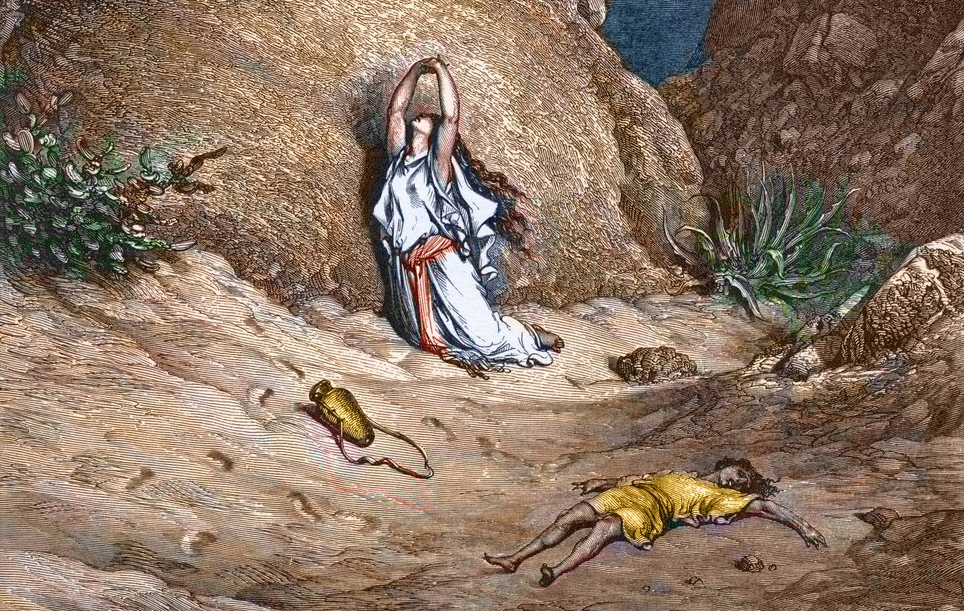
Several women shared about significant losses that they had suffered, particularly career loss, a pain that I know firsthand sharply. The words that kept arising from deep within the recesses of others’ hearts were ones like “discounted,” “disposable,” and “unnoticed.” In the course of this hour someone mentioned Hagar, an Old Testament woman we meet in Genesis. Her story is both one of profound loss and also of survival. When God provides for her in the wilderness she names Him. She identifies His presence and ponders: “Have I really seen God and lived to tell about it?” So from then on she called him, “The God Who Sees Me” (Gen 16:13). The point in our discussion was clear. Here, on this fragile, fractured planet, some of us may never know what it is like to be noticed by those we seek attention from, love, or desire to serve – those who should have protected us. We will and very often do feel unnoticed in our workplaces, our churches, even our homes. But Hagar is right. God sees us. He does not pass over our pain.Moreover, it is in naming, giving voice to our experiences of loss and survival, and identifying God amidst all of this that it becomes possible for healing to take place. Hagar’s story is similar in character to what the women in our reading group practiced in the discussion that brought Hagar to the forefront of our imaginations. By naming both our wounds and our interactions with the God we meet in these places, we find resiliency.
There is something powerful about this interaction: Hagar, a woman marginalized, dispossessed, oppressed, has the freedom and, frankly, the boldness, to give name to the Creator and Sustainer of the entire universe, of all the galaxies. How can she, a woman made small by the mistreatment of others, dare to name God Himself, something not even the patriarchs, God’s chosen servants, had yet attempted to give voice to? Certainly, this encounter is one to marvel at, be in awe of – but I believe that to appreciate its full import, in our own culture, it is helpful to understand the value and significance of the act of naming, claiming both our sufferings, and identifying God Himself in these tender places.
What’s in a Name? The ‘Capulets’ and the Catechism
In our contemporary data-driven and digital age we can easily overlook the importance of naming and of reverencing a name, especially one’s given name. However, this devaluation of names dates to long before our current crises. I am reminded of Shakespeare’s play Romeo and Juliet. In ninth-grade I had to memorize and perform Juliet’s soliloquy: “What’s in a name? That which we call a rose / By any other name would smell as sweet” (Romeo and Juliet 2.1.46–47). Although posed as an innocuous question, at its core is a challenge of enduring import. Is one’s name artificial, an imposed-upon label, or facile title? There is great romance in Juliet’s discounting of the name of “Capulet” – but it is worth pondering whether it is compatible with a Judeo-Christian worldview. After all, do we not believe that one’s identity is inextricably tied to one’s relations and affiliations, especially familial ones? As the Second Vatican Council teaches, “Man … cannot fully find himself except through a sincere gift of himself” (GS 24). In other words, one does not construct an understanding of self apart from how he finds himself in relationship to the other. Or reflect on Pope Francis’ words: “for ancient peoples, to give a name to a person or to a thing … was to establish a relationship” (Patris corde, preface). It would appear that a name is far from arbitrary, and is bound up with the relationships and affiliations without which we cannot come to know ourselves or the other.
Tar, Turpentine, and Tattoos: On the Depersonalization of a Name
Even without the reliable guide of Scripture and Tradition, I believe we still have an intuitive sense of the lasting salience of the name and of the act of naming. Furthermore, we know that to seek to remove one’s name is an act of depersonalization, and to a certain extent, even disembodiment. We need look no further than some of our established institutions which, in a desire for efficiency, reduce the human person to a number. Reflect on the way we can be quick to hear a statistic and fit someone into a category instead of encountering the distinctiveness of his or her human story. And even as we do this, we know that something transformative occurs when we learn the name that the number represents or even a descriptor of that individual. Possibly the most haunting example of this phenomenon is the way that the Nazis in the Holocaust stripped the Jewish people of their respective names and branded them with numbers, attempting to strip them of their human dignity. Who that knows can forget the image of a person’s tattooed forearm?
Toni Morrison’s essay, “Moral Inhabitants,” discusses the horrors of the Atlantic slave trade. She recalls how in the Historical Statistics of the United States, an official publication of the United States Census Bureau, enslaved people were not accounted for by their names, but by a mere headcount, a tally. Stuck between names for consumer goods like “tar,” “turpentine,” and “rice,” was the number of enslaved peoples shipped, revealing that the traders thought no more of these human beings than that they were something to be utilized, consumed, and finally discarded. Of course the question that occurs immediately is, “How many were shipped?” But our inquiries ought not to stop there. Morrison immediately prompts more painful questions: “Was there a seventeen-year-old girl with a tree-shaped scar on her knee? And what was her name?”2 Morrison senses that to know someone is to recognize and acknowledge her distinctive identity, to know a description of her and to acquire and acknowledge her name.
On Chaplaincy and Charting: Acknowledging Naming in Clinical Care
And if only the tendency to erase the human person by exchanging her name for a number were a thing of the past! It is tempting to villainize the Nazi or the slave trader, making them a symbol of a past evil that surely everyone now abhors, without considering practices in which we are complicit that have a similar character. But I know from personal experience that in our age there are still practices embedded within our institutions, even institutions designed to care for and work benevolently for the human person, that can work to erase individual personhood. Ironically, I first encountered this reality when I began my work as a hospital chaplain.
When I first began my residency I was elated at the prospect of working on an interdisciplinary team to address the whole person: mind, body, and soul. In the secular world the role of a chaplain has much to do with the ministry of presence, recognizing the fundamental value of the patient and listening to the sacred stories of the other. Worded another way, while a nurse distributes the proper medication and checks the vital signs of those under her care, a chaplain could write about a patient’s background, relationships, and underlying sense of self, of others, and even of the Transcendent. Capturing these more immaterial spiritual and emotional realities so that the medical team was aware of them could prove helpful in both addressing needs holistically as well as helping them navigate more practical matters like ethical consultations and end-of-life discussions. I had a strong sense that I was aiding others in serving the human person multi-dimensionally, and so I looked forward to composing my charting notes instead of regarding them as a nuisance. When reading notes to learn what I needed to do when interacting with the hospital patient I was caring for, I noticed that many medical providers referred to the patient in their notes as “patient,” or as an abbreviation, “pt.” The practice did not really give me pause – I know that in the medical world efficiency matters more than perhaps anywhere else and the medical providers’ goal was to give factual detail, not necessarily to capture a story. I was all the more delighted at my particular duties, which allowed me to spend more time with patients, cherishing their stories, engaging in what we referred to as “life review” with them and even at times inviting them into imaginative prayer. I charted using the patient’s name until conflict arose.
My first supervisor praised my compositions. The next supervisor would challenge me, however. He instructed me that I needed to expunge from my notes the names of the people I was ministering to. After all, I was there to participate in the hospital’s business, not to “write love notes.” This instructor seemed to believe that a healthy detachment was necessary to provide care to others. I felt unsettled by his perception. We were story-bearers; how could we separate one’s story from his or her very name? The message was clear to me. I had to learn to cope with “maintaining a clinical distance” from the patients I was attending to; but his way of doing so struck me as a failure to see my patients in their totality. It is in conversation with sources like Toni Morrison’s writing that I now know that my impulse to be unsettled was just. We need to learn as a culture even on the institutional level that blindness to the fullness of someone’s identity cannot be justified as self-care or self-protection.
An Understanding of Biblical Calling: Reflections Regarding the Person and Our Original Task
The biblical view is that a person’s name expresses something of his or her character and therefore is inseparable from the person so named. Is there not something lasting, eternal, or enduring about the act of naming, for instance, by which God speaks the cosmos into existence in the Genesis accounts? I have always been captivated by the means through which our God brings about order and life outside of Himself, speaking the observable world into existence through an act of creative love, through language and naming. It is through His Word’s naming of creation that life both begins and is sustained. We worship an omnipotent God Who creates from nothingness. And so I trust that He could have created in any way He regarded as fitting. He chooses to do so by issuing forth language, by the act of proclamation. Why? While I may never have a total answer to this query, I do have a few thoughts.
First of all, I am convinced that there is an intimate connection between God’s divine work and the charge He gives Adam, the first human creature crafted in the image of God to fill the Earth and have dominion over it. Moreover, I believe this connection has ramifications for all of us made in the imago Dei. As Fr. Mike Schmitz says frequently, “the human person was created for love, labor, and leisure.” Fr. Schmitz’s vision is a compelling one because what he outlines as the human person’s mission echoes God’s act and character described in Genesis 1–2. As our faith teaches, long before the creation of the natural world, the Triune God existed in a loving relationship with each Person of the Trinity. It is from this Love, which is Himself, that God then makes the decisive act to labor, establishing order and designing creation from His word. Finally, at the end of this time, Scripture says that the inexhaustible God, the One who does not grow faint or weary, rests, or engages in leisure.
He then commissions Adam to participate in a similar act by tasking him with the work of naming the animals. What does this naming exemplify? I believe it demonstrates that, much like his Maker, the human person is fundamentally creative, and furthermore, that the establishment and continuation of language is a creative endeavor itself. It is as if God is a loving father who goes beyond pointing to images in a picture book, but actually sits down and asks his child for the names of all that he sees, and lets the imagination of the child run wild. Naming also reveals that something or someone is in a living relationship with the other. For God, naming displays His divine sovereignty over creation. For Adam, and by extension the human person, naming has a correlation to the larger assignment of being entrusted with watchful care over the natural world. And perhaps most significantly, I believe that naming has an epistemological quality to it. By this I mean that man, in his desire for the concrete, learns his place in the world and also the nature of something through discovering and claiming its name.
Helen Keller and the Incarnation: On the Embodiment of Language
To develop this particular point, I will visit a remarkable insight from Helen Keller’s memoir, The Story of My Life. Keller, American author and disability rights advocate lost her sight and hearing at the tender age of nineteen months old. Through the mentorship and relationship she formed later in her childhood with her first teacher and lifelong friend, Anne Sullivan, Helen would learn language, to read and write, and, in doing so, identify its power. I find it most compelling that Keller divulges that she did not understand either the meaning or import of love until she learned to sign it, to embody it, literally, with language. She attributes the discovery of abstract meaning and language to Anne Sullivan, but is not love the summit of all that is inexpressible? Keller writes, “I remember the morning that I first asked the meaning of the word ‘love.’ … Miss Sullivan put her arm gently round me and spelled into my hand, ‘I love Helen.’ ‘What is love?’ I asked.”
Keller recounts, then the import of this word dawning upon her days later. Anne Sullivan then communicated to Helen, in a way that a child could understand:
Love is something like the clouds that were in the sky before the sun came out. You cannot touch the clouds, you know, but you feel the rain and know how glad the flowers and the thirsty earth are to have it after a hot day. You cannot touch love either, but you feel the sweetness that it pours into everything. Without love you would not be happy or want to play.
Helen Keller, The Story of My Life (Garden City, NY: Doubleday, 1954), 40–41.
And while I am certain that this depiction illuminated in Helen Keller’s mind what love really is, the first step was finding a way to embody or sign the word.
For as long as I’ve known this story, I’ve been greatly moved by it. But I remember attempting to explain it to my cousin once. I shared with him that Keller truly couldn’t understand love until she learned to name it, to sign it. He responded with a bewilderment that came largely from his conviction that love itself is unknowable, indecipherable. It is my impression that he reached this conclusion because of the way “love” in contemporary culture is an ambiguous word with a multiplicity of meanings. But, in the Christian tradition, can we arrive at a place where we know what love is? I believe so. Love is a Person who bears the name Jesus Christ and Emmanuel, God with us. Love is the Word described in the creation accounts: it is enfleshed, embodied. Love, then, becomes as tangible and concrete as the signing Helen Keller formed. Indeed, Truth itself, the Word, the Person who names the visible world, becomes concrete and, to that extent, knowable. Thus, Keller’s recognition of love emerging from her ability to articulate it physically has profound incarnational resonances. It is in this way that all Scripture, from the very beginning, as well as the breadth of the human experience, point us to the person of Christ. Before we explore this thread and its eternal value, though, I wish to reflect on the person of Hagar, the woman who first inspired this contemplation. Who was Hagar, what might she teach us about the human person, unveil to us about ourselves, and, ultimately, how does her witness also direct us toward the Incarnation?
A Return to Hagar
We encounter Hagar early on in the Book of Genesis. She is a character who is neglected by those living alongside her who should have protected and provided for her. What do we know of Hagar? We know that she is an Egyptian woman and a maid to Sar’ai but her very identity seems tied to her mistress as the text reads: “She [Sar’ai] had an Egyptian maid” (Gen 16:1). She becomes the mother of Ishmael as the story continues. But there are no words that speak to the sorrow, fear, desperation she was asked to carry. At Sar’ai’s bidding, the patriarch Abraham has relations with her in the hope of begetting the descendants God had foretold. Later, Hagar becomes the recipient of harsh treatment from Sar’ai, and responds by fleeing into the wilderness. It is in the wilderness that God sees her affliction, her maternal need, and provides water for her and the child within her womb. It is through this deliverance that Hagar comes to know God’s character and names Him, accordingly, “El-roi,” or “the God who sees” (Gen 16:13). He sees her.
But do I, the reader, see Hagar? And not only for her relations, but as a biblical woman with intrinsic worth? Can I reimagine her with my own creative lens in such a way that I can perceive her with greater clarity? I see Hagar from the very beginning, asked to share relations with her mistress’s husband in the hopes of fulfilling a promise that is not hers to participate in or possess. Is it not enough that her body is not strictly hers, but an instrument wielded in an attempt to secure someone else’s child? And what does this act produce but the wrath of her mistress, so much so that Hagar feels that her only option is to flee to the wilderness while pregnant? She must have regarded herself as entirely dispossessed and discarded by the very people who should have protected and preserved her fragile existence. And I imagine her, heavy with child, resources running out, pleading for survival, close to giving into despair when she encounters God – yes, the God who sees.
Hagar is in every way dispossessed, and yet she summons the courage to name her experience after fleeing into the wilderness, to actually name God Himself. How did she arrive at a place, within herself, where she possessed the boldness, courage, what some might even say is the audacity to name her Creator? And what does her bravery indicate about healing and recovery for all of us who have experienced the wilderness of disorientation after surviving a trauma?
Naming Our Trauma: Psychological and Personal Insights
In the discipline of human psychology, trauma studies are growing in increasing popularity. Many of the insights this field formed emerged from observations of the mid to late twentieth-century as attentiveness was given to veterans returning from World War II and the Vietnam War. These wars were distinct in character, though they occurred closely together. In the case of WWII, it is still difficult to fathom the great evil that took place and the price to be paid by the entire globe. People returning from the war, especially in the West, would receive honor and recognition from their fellow citizens but many veterans still felt changed by what they had seen, unable to readjust to civilian life. As far as the Vietnam War, we see a war that occurred on a smaller scale, after which soldiers returned not to recognition from their fellow citizens, but to rejection, disavowal, abandonment. They gave up their lives for what they were told was a greater cause and were treated harshly upon their return. (Can we not see the spirit of Hagar in this history, one who gave up her body for a greater cause only to receive rejection from her given community?) And still, in the aftermath of both wars, we gained the critical observation that those who found spaces to speak of their experiences tended ultimately to have greater resilience.
Today, our society uses the term “trauma” ubiquitously. I find myself worrying that this practice has become excessive in Western culture, perpetuating a “victimhood mentality.” Still, I remain grateful that we have developed a language to discuss events and their effects that we used to bury within ourselves. As I researched this topic and reflected on how it relates to Hagar, I discovered a plenitude of articles that advocate for the invaluable practice of not only speaking, but naming one’s trauma, essentially finding a vocabulary for it.
While Hagar doesn’t exactly name her traumas, she does name God. Is it possible that, through this act, she comes to know the character of the One whose very essence is unknowable, perhaps even more strongly than the Patriarchs? Does Hagar understand and embrace more fully through being provided for by God and naming Him an experience that could have otherwise only prompted fear? And does this shift in understanding give her the ability to respond to God’s instructions to leave the place she’s in and return to her given community with a renewed sense of agency and purpose?
Naming your trauma, however, or your most intimate experiences, is a modern insight, even as I believe its power and effect have always been true for the human condition. Hagar does not have access to the fruits of modern-day psychology. She cannot possibly know that this act of naming God is an act of resiliency or healing, as we now refer to it. And yet, something in the deep recesses of her heart draws her to this movement, and she responds accordingly with naming, or accessing her poetic voice. It is precisely the people on the margins, those who do not experience being the chosen ones, individuals who inhabit space outside of the covenant, that often have a unique ability to access what I will refer to as their poetic voice.
To illustrate this point, I would like to share from my journey of recovery or healing from my past trauma. After I experienced what I regard as the unfathomable, I paused many of the relationships I once cherished. Without divulging too much, I will say that I did not anticipate the depth of pain that I endured and so I was left uncertain as to how even to begin processing it. At the time of this suffering, I lacked the skills to articulate in language all that was occurring within me. Language is a survival tool, but I was left dispossessed of it. I retreated into myself. And still, I was loved patiently by others, and seen by God when I was not just stumbling but drowning, and the ground that once felt steady collapsed beneath my feet. I was left totally uncertain of myself and my place in the world, and yet I was never abandoned, never forsaken. Slowly, over a great length of time, I began to learn a new language, one that could hold the weight, the sheer gravity of my adversity. Naming gives us space from what we’ve lived through or are living through, allowing us to observe it rather than drown in it. This metaphor is imperfect for my experience, because I had in fact drowned. But I was slowly resurfacing, rising from the depths of the ocean. And then when I was ready to express all that was within my heart, those from whom I had alienated myself because of my inability to access the transformative power of language were somehow still there, and miraculously eager to listen. They offered me such attentiveness as I began to claim my poetic voice.
To make this more concrete, I will share that I recently conversed with a friend from my early adolescence with whom I had not spoken in several years. When I spoke of my pain with this friend, he listened carefully to me. Even with distance, the space between us, miles apart, he made me feel so seen and known. And when I had finished revealing all that was within my heart, he accessed his poetic, and really prophetic, voice to say the following: “There are those who are drowning in the ocean, entirely submerged by it [their trauma] and therefore cannot speak, give voice, even breath to their struggles. There are others who are residing on the shore still and do not witness, cannot even see the perils that those drowning are encountering. And there are still others, once drowning in the ocean, who have come above the surface just enough to give voice, a name to the struggles found within its depths.” These people inhabit an in-between space and it is precisely because they do not belong fully to either described category that they can speak poetically and powerfully both of the suffering they endured and to the power that revived them. If I am living in that in-between space, did Hagar inhabit this space as well? Is that what it means to live on the margins, to be outside of the covenant and still loved by God, or to find water in the wilderness?
Our God El-Roi: God’s Provision and Preferential Option for the Poor
I do very much mean that God not only protected or provided for Hagar but saw and loved her. When I read the Gospels, I am struck by Christ and his devotion to the poor, which truly suffuses every page; but I sometimes fail to see the unity of wills between the members of the Trinity. I sometimes fail to see that the God portrayed in Genesis is the same God who privileges the poor in the Gospel accounts. I can’t exactly identify the source of my lack of comprehension except to say that I often focus my attention on God’s work through the covenant, the chosen ones, and how undeserving they appear to be of his benefits. There are times in my life that I feel like God passes over my suffering, that I live on the outskirts of culture, even church culture, on the margins. And so in my theological imagination I often feel deeply for those who do not, indeed cannot, obtain the Abrahamic promises. But as a friend pointed out to me, “in the subsequent biblical narrative, the poor and dispossessed are shown to be under the special protection of God.” Consider Exodus 22:21, where God commands His people to not wrong or oppress the stranger because they themselves were once strangers in the land of Egypt. This passage fascinates me because Hagar is herself a foreigner, a stranger from Egypt, the slave of a family that would later experience slavery themselves. Or read Psalm 72:12, which states: “For He delivers the needy when he calls, the poor and him who has no helper.” Is this not Hagar, a woman without the consolation of a friend in a terrible place of need? Or look at Psalm 146:7–9 which describes God’s care for the sojourners and the widow. Hagar is a sojourner, both in having been brought from Egypt and also in her time of fleeing from her mistress. And while we know little of Hagar’s familial ties, we can recognize her as a virtual widow, as she lacks spousal protection in her affliction. I’ve always wondered if God’s special protection for the poor transcends mere pity. That is why I desire so much to believe that those in poverty have a particular opportunity to create and claim a poetic voice, one that pushes beyond the boundaries of the covenant, and even challenges or contends with what it means to be chosen. Hagar is the fulfillment of this hope and desire that swells from within me as she dared to give voice to her experience of God and as she who was dispossessed comes to possess the creativity and boldness to attribute language and name to God.
But if I really want to know if God’s love for the poor transcends my understanding of pity then the place I should be looking is the Incarnation itself, where God actually becomes impoverished, emptied, dispossessed for the sake of all whom he loves, for all of Creation. He not only sees, therefore, the affliction of Hagar: He becomes like her, so that there is no suffering that she and those like her endure that is foreign, that is not undertaken by Him. When I contemplate Christ’s solidarity with suffering, my gaze turns immediately to the Cross. But I believe Christ’s whole life, from His conception to his atoning death, was marked by His resolve to enter into places of desolation and redeem them. Christ also, the Word intimately involved in creation, wields His distinctive poetic voice through His teachings, demonstrating the power and value of creative language Himself. Truly, even before His birth, his mother Mary, a woman like Hagar in several respects, speaks of His arrival in poetic terms. This suggests that there was a poetic voice present from Christ’s conception to His Crucifixion.
From Conception to Crucifixion: Contemplating Christ’s Poetic Voice
Let us begin before Christ’s birth at the scene of the Annunciation. Mary inhabits a place on the margins too: similar to Hagar she is also a young woman in a patriarchal culture. Both these women experience the arrival of an angel who instructs them on how to proceed with the arrival of their child. Moreover, in the case of Hagar, she gives God a name, and in the case of Mary, the angel Gabriel invites her to name her Son with God’s own name: “You shall call Him Jesus, for He shall save His people from their sins” (Matthew 1:21). Both of these women respond to their revelations by accessing their poetic voice. We hear this in Hagar’s naming of God and with Mary in the scene of the Visitation. As Dana Gioia, a poet in his own right, describes in his essay, “Christianity and Poetry”: when Mary, in wonder and joy, utters the words of the “Magnificat,” a poem that emerges from within her heart, this is “the first time the mystery of the Incarnation is shared with the world. Mary does not report the news in factual terms. She speaks the words of a poem.”3 And what does this poem portray but the same character of God that Hagar witnesses in the wilderness? For Mary proclaims: “He hath put down the mighty from their seat: And hath exalted the humble and meek: He hath filled the hungry with good things: And the rich he hath sent away empty” (Luke 1:52–53). In this manner, Jesus’ life has a tie to the poetic voice from His earthly conception.
As Jesus’ life progresses and He enters His ministry, He too employs a poetic voice, utilizing creativity in His teachings. Why? As previously described, poetic language has the ability to transform experiences; it is a skill that brings about healing, a kind of healing that involves the whole person. As Gioia expresses it, “he told them [His followers] stories in which they could see themselves. He spoke to people as creatures with both a body and a soul. He addressed them in the fullness of their fallen humanity, driven by contradictory appetites, emotions, and imagination.”4 The poetic voice is palpable in the parables, as well. That is to say, parables illustrate pictures, portrayals, even landscapes that we can then enter into with our whole selves. As the Psalmist writes, “Oh taste and see that the Lord is good!” (Psalm 34:8). Christ desired not merely to lead us to intellectual assent: in an even more holistic way He sought for us to know him experientially, to hunger and taste, look and see His goodness, such that it would make us whole. He wanted us to know Him, Eternal Truth Himself, and His Kingdom “emotionally, imaginatively and experientially – all of the ways in which humans understand this world and imagine the next.” He accomplished this in His teaching largely through wielding the poetic voice. And while perhaps the most obvious example of Christ’s poetic voice is the formation of parables, there are more examples of this act. The Christian tradition looks on Jesus’ Beatitudes as the summit of Christian teaching, and “What are the Beatitudes but a poem carefully shaped in the tradition of prophetic voice?”5
Hagar and Christ: A Typology
And then, ultimately, we move to the Crucifixion, in all its stark brutality, and Christ’s last words: “My God, My God, why hast Thou forsaken me?” (Matt 27:46). We can understand this agonizing cry as both Christ’s earnest lament that comes from a place of His experienced abandonment and an allusion to a book of poetry, the Psalms, where the Psalmist utters the same cry (Ps 22:1). It is in this way, that we can say that the entirety of Christ’s earthly life was poetic.
In all of these ways, we perceive parallels between the trajectory of Christ’s life and Hagar’s poetic action, her naming God in the wilderness: “You are El-Roi, the God who sees” (Gen 16:13). In another sense, though, I believe Christ’s lived experiences contrast Hagar’s. For instance, both of them enter the wilderness, but in this landscape, their observations, what they see is different. Hagar meets God and wonders, “Have I really seen God and still lived?” (Gen 16:13). She experiences thirst and finds provision. Jesus enters the wilderness and experiences true hunger but is the recipient of temptation instead of nourishment. While Hagar encounters God in this desolate place, Jesus does not hear His father’s voice, but the deceit of the Enemy. In Hagar’s desperation, she comes to know the God who sees, the God who sees her. And in Christ’s climactic moment of suffering, the time of His utmost desperation, He experiences the turning of His Father’s gaze away from him. Here, Christ submits to a fate which isn’t only far greater, but really the opposite of Hagar’s. And though we marvel at the Mystery of the Cross, and never plumb its depths, I do think I can say that Christ experiences this sense of abandonment so that there is no place, no experience of godforsakenness where God is absent, distant, or removed from the sufferer.
A Blessing for Those In the In-Between Journey
Through this sacrifice, Christ expanded and magnified the scope of those who belong to Him, drawing all of Creation to Himself. He established the New Covenant, where those who had never experienced a sense of belonging to God or chosenness could find entrance and intimacy. So often we rush to the hope of the Resurrection, and while I understand the impulse, I also believe that many of us feel that we live in the space between Crucifixion and Resurrection. We live perpetually in a kind of Holy Saturday, sensing the Kingdom of God, sometimes even catching a glimpse or experiencing a foretaste of it, but still living in what some have referred to as the already and the not yet. But could it be that very tension that gives birth to hope? I mean, not merely a wishful feeling, but resistance born from the struggle of seeing the Kingdom in the distance and continuing to live as a sojourner?
So many of us, while sensing Christ’s embrace, still endure experiences of isolation and alienation, not even in our wider society and culture but even in our own churches. As Hagar felt cast out by her mistress, so we feel exiled from the very people that we desire the most to know and see us. Here, at the end, I wish I could offer a solution to those who feel the most disposable, discounted, and overlooked, especially by the institution of the Church Herself. Nothing that I could ever say, however, will silence that pain – the one that knows the in-between space, the pause between how the Kingdom of God could and should be, and its broken dominion now here on earth. Life is not as it should be. Period. What I can say is that your pain, when surrendered to God, can be a catalyst for creative transformation. Moreover, I am convinced that it is in naming both your suffering and the God who dwells in it, really your full experience, and finding language from the depths of your distinct woundedness that you will experience healing and grow in resiliency. But even more than that, I believe that as you acquire the skill of naming these ruptured places, you will develop a poetic voice.
May this voice equip you to observe through a unique lens and call by name God’s character and how He acts both in His created order and in the lives of others. May you find friendships, partnerships, affiliations where you can minister to others even as they recover from their personal sufferings and learn to wield their poetic voice. And may what you create through the power of language broaden, deepen, and heighten our vision of an all-encompassing Kingdom of God, one that looks like wholeness. As you labor in this creative love, my most earnest prayer is that you will know not only El-Roi, the God who sees, but the God who freely, through the sacraments, communicates “as poems do, to the full human intelligence—body, mind, and soul—without asking [us] to divide ourselves into anything less than [our] total identity.”6
