
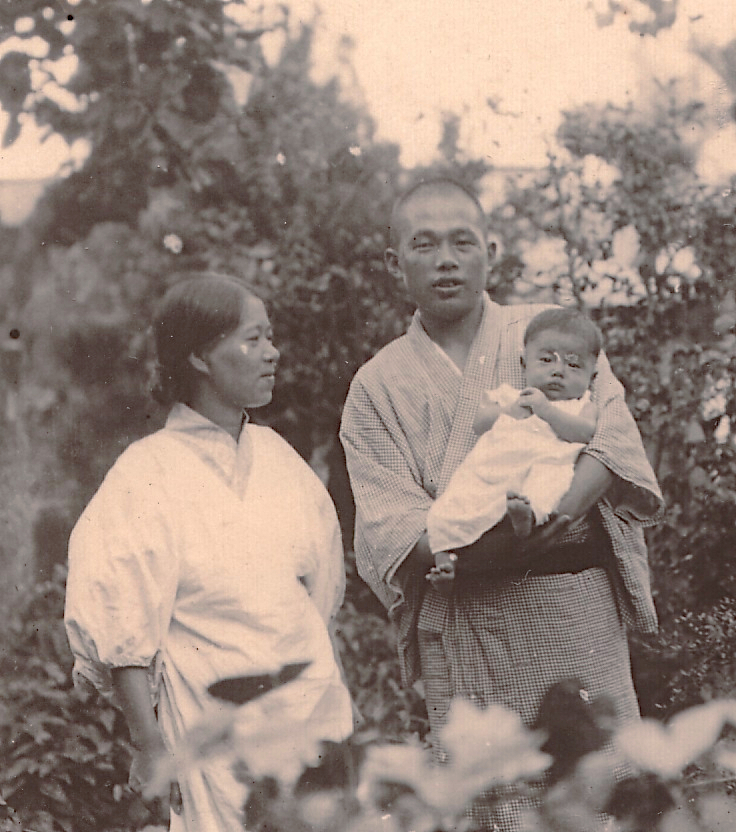
Takashi Nagai with his wife Midori and their son Makoto in May 1936 | Wikimedia Commons
There is a strain of nihilism that has permeated through the West. News about tragedy and wars, whatever they may be met with, are not received with prayers or concern but rather cynicism that nothing can get better. The view that the world cannot be changed by our actions in these horrible times has paralyzed the youth into believing that they themselves do not matter. We as a culture are not fazed by the pains of life because if we acknowledge their gravity then we would have to admit that there is no answer to our suffering from the viewpoint of the natural world. One does not need to look far to see nihilism in our culture, as seen with obsessing over the end of the world: we both fear the worst and yet want a conclusion to life that makes it meaningful. And yet, we in the 21st century have been denying that life has a meaning when we want there to be one.
The atomic bomb is the perfect example of this. Many have resigned to their fate that there is no hope in a world with nuclear weapons. Final utopian peace has become impossible. It is only a matter of time before we annihilate ourselves. Pope Francis said in 2019:
The use of atomic energy for purposes of war is immoral, just as the possession of atomic weapons is immoral… Future generations will rise to condemn our failure if we spoke of peace but did not act to bring it about among the peoples of the earth. How can we speak of peace even as we build terrifying new weapons of war? How can we speak about peace even as we justify illegitimate actions by speeches filled with discrimination and hate?1
What the philosophy behind the bomb gave mankind was the realization that materialism, atheism, or whatever cynical “-ism” you like, is unsatisfactory. We as a species have to come to grips with the reality that either love or nihilism is the universal truth which governs the universe. Humanity has the power to destroy itself and in the cynicism of our age it is no wonder why there is little hope for the future.
People have adopted such a low view of humanity in some instances that there is a growing sentiment that it isn’t worth being saved. This, however, is in contrast with the words in the Gospel of John:
For God so loved the world that he gave his only Son, so that everyone who believes in him may not perish but may have eternal life. Indeed, God did not send the Son into the world to condemn the world, but in order that the world might be saved through him. (Jn. 3:16-17)
The Christian hope is that despite the horrors of the world there will always be light. That is all well and good, a skeptic might say, but what about the existential threat of humanity annihilating itself? Albeit the atomic bomb or some other great weapon hellbent on making us suffer meaningless death? What good is this Christian hope in our modern age, where we face new threats that go beyond the imagination of a medieval peasant’s mind? What the skeptic might not be aware of is that the Christian peasant is not a character of fiction, they are ordinary people who took the cross of Jesus. Anyone anywhere can become a model for Christian hope. The body of Christ has a servant of God who has met the abyss of nihilism from the modern lens and stared back with eyes full of Christian hope. There was a man who had suffered one of the darkest moments in human history and lived to tell the tale, proclaiming the Gospel with his actions and repentance for humanity’s sins.
Dr. Takashi Nagai was a Japanese medical doctor who had grown up in a culture of traditional Shintoism which he rejected as a young adult for materialistic atheism. He would be a man of science, which he believed meant denying that the world is anything but material. And yet when he witnessed his mother pass away he discovered that this perspective was wildly insufficient:
With this last penetrating look, my mother demolished the ideological framework that I had constructed. This woman who had brought me into the world and raised me, this woman who had never given herself a moment of rest out of her love for me, spoke to me very clearly in the last moments of her life. Her look told me that the human spirit continues to live after death. All this came as an intuition, an intuition that tasted of truth.2
Her life was not satisfactory if this was the end. This led him looking more deeply into philosophy to try and unpack the mysteries of life.
His time as a soldier in the Second Sino-Japanese war in the mid to late 1930s would also provide a breaking of his Atheistic outlook on life. Science could not explain the human experience wholly nor satisfy man’s hunger for meaning. Takashi’s comrades in arms had died around him in modern warfare that was not symbolized by heroism but rather as cynicism in numbers of a force. Atheism did not bypass the problem of evil, nor did all of the wisdom of the secular world.
On Christmas Eve, 1932, Takashi met a humble school teacher named Midori. She was a faithful Catholic Christian whose ancestors had been persecuted till that time by the Japanese government. Midori was a great witness to Takashi. She told him of her faith and gave him a catechism to read about the Church. She revealed to him that the Gospel is not a set of ancient books but rather the experience of a divine person, one whom Takashi says he encountered that night: “I felt someone close to me that I didn’t know yet.”3
Takashi adopted Midori’s convictions in the existence of God and Jesus Christ. He was baptized as a Christian in 1934. Takashi and Midori would be married sometime later, having four children.
Takashi’s wrestling with atheism and its place in the world is crucial for understanding how he absorbed the bombing of Hiroshima and Nagasaki. The day the bombs dropped Midori was caught in the blast. Her only remains were bones and a rosary melted in her fingertips:
What was that black lump over there? It was Midori. There was little more than the charred remains of her skull, hips and backbone. He could see she died in the kitchen that she loved. Sobbing, he picked up a heat-buckled pail and knelt to gather her bones. 4
The woman who had shown him the light of the world had perished in the light of the blast. For the Japanese who had experienced the atomic bombings, the aftermath looked as if they were in hell on earth. Witnesses to the event observed that the survivors were like zombies, the dead walking on earth.
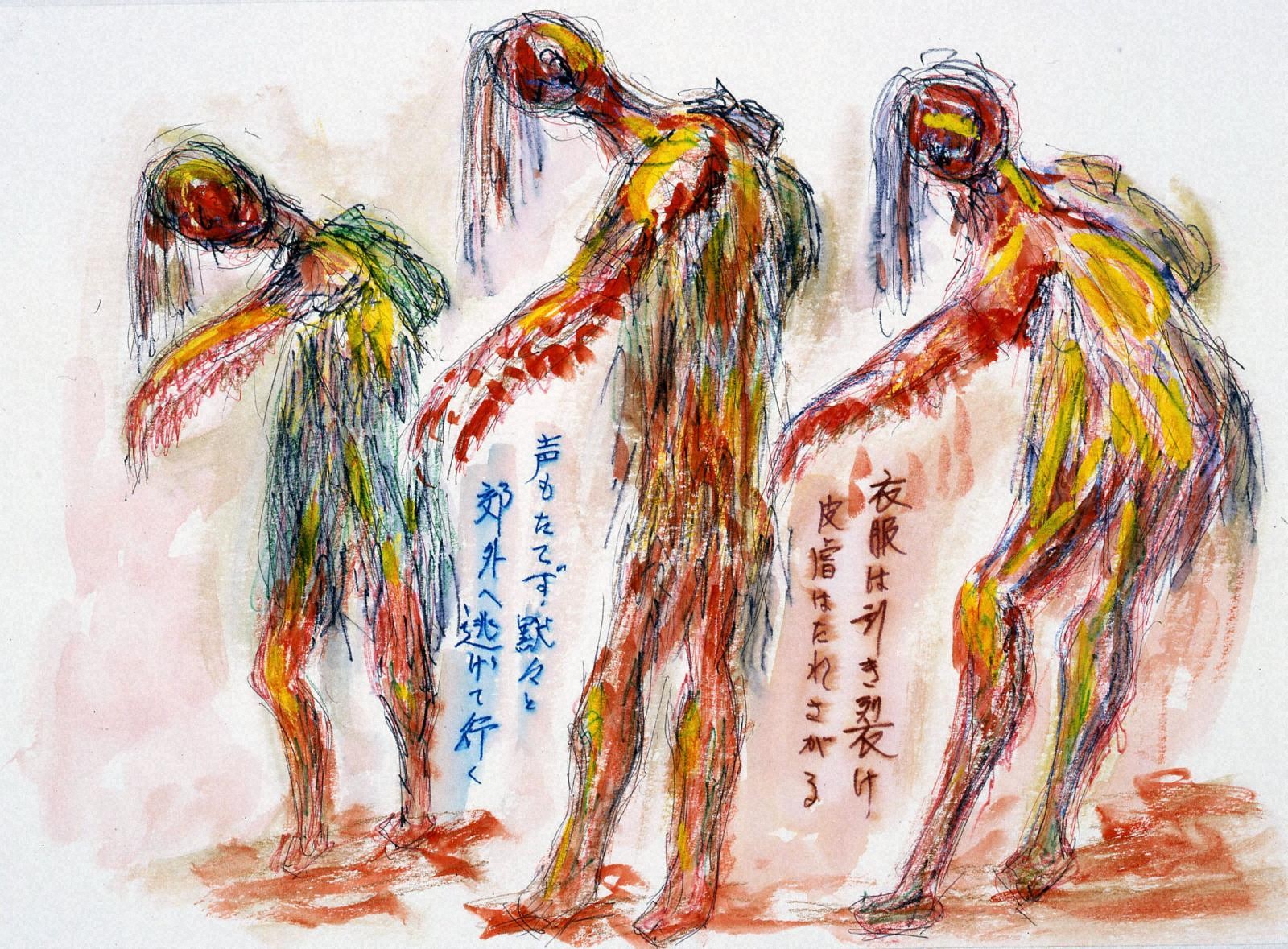
What was that black lump over there? It was Midori. There was little more than the charred remains of her skull, hips and backbone. He could see she died in the kitchen that she loved. Sobbing, he picked up a heat-buckled pail and knelt to gather her bones. 6
The bombings were a horrendous act which created a new existential threat which annihilated human complacency. Humanity had finally found the means to kill themselves. It was a suicidal ideation from means of weaponry. No more did wars need to be fought by soldiers when governments could end it all at the press of a button. From here on out, the world would always be plagued by the prospects of Nuclear War and the nightmare of self-destruction. It is hard to try placing God in the middle of this, and yet Takashi had praised God for his goodness:
Dearest God, thank you for allowing her to die praying. Mother of Sorrows, thank you for being with faithful Midori at the hour of her death.
Takashi’s book The Bells of Nagasaki explores his theological mediations of the bomb through this work. He did not have any reservations about condemning the sins committed in the second world war, correlating the destruction of Nagasaki as a sacrifice for the sins committed. Nagasaki would become vital in his theological mediation because this was where the hidden Christians had ended up, as the city would become the center of the Catholic Church in Japan. To have it stripped away after all the persecutions and sufferings only for this great pain must have been torture for the man, and yet he had reminded himself of Job in his sufferings: “The Lord has given: the Lord has taken away. Blessed be the name of the Lord!” (Job 1:21).
Life is a gift given to us by God. Everything we have or could ever have is a gift from him. Our wealth, our community, our every breath. Takashi knew this, as he quoted from Job. Job had gone through much suffering, which from his point of view came out of nowhere and was needless. The Christians in Nagasaki had been rewarded for centuries of persecution only to share in the country’s nuclear holocaust. Yet, Takashi had prayed and hoped that in the end this would be a holy and good sacrifice that would mean that no one would have to experience anymore the crimes of humanity:
Is there not a profound relationship between the destruction of Nagasaki and the end of the war? Nagasaki, the only holy place in all Japan—was it not chosen as a victim, a pure lamb, to be slaughtered and burned on the altar of sacrifice to expiate the sins committed by humanity in the Second World War?
The human family has inherited the sin of Adam who ate the fruit of the forbidden tree; we have inherited the sin of Cain who killed his younger brother; we have forgotten that we are children of God; we have believed in idols; we have disobeyed the law of love. Joyfully we have hated one another; joyfully we have killed one another. And now at last we have brought this great and evil war to an end. But in order to restore peace to the world it was not sufficient to repent. We had to obtain God’s pardon through the offering of a great sacrifice…
…We Japanese, a vanquished people, must now walk along a path that is full of pain and suffering. The reparations imposed by the Potsdam Declaration are a heavy burden. But this painful path along which we walk carrying our burden, is it not also the path of hope, which gives to us sinners an opportunity to expiate our sins?7
There is a telling difference between Takashi’s rich theology and the cynical nihilism of our age. Informed by the Gospel, Takashi is a witness who reveals the truth behind the bomb from a spiritual dimension. For him this is an opportunity to offer up the horrors of the atomic bombing as a sacrifice in a sort of redemptive suffering. His hope with this sacrifice is that no one else will have to suffer the same pains as those who were subject to the bombings. This is a stark contrast to modern secular man. Those who fear the atomic bomb in a nihilistic sense hold a belief that this material world is all that there is. These cynics have deemed mankind in its fallen nature as unsalvageable. The only way to live from here until the end is to numb ourselves with detachment from reality. Takashi rejects this idea wholeheartedly. The servant of God identifies the sins committed by the dropping of the bomb and the second world war and yet sees that this is a chance for his people to repent. He displays faith in God’s ability to make goodness flow from such a tragedy, that this witness can be used for Jesus’ mission. No tragedy however great is removed from the providence of God.
The conclusion of atheism is unsatisfying to the human condition. Man knows that there has to be more to life than just suffering. Atheism offers no answer for suffering except that it is the eventual fate of the human race. There’s no hope or optimism grounded in reality, only cynicism because man alone cannot solve his own problems. It is obvious that we cannot save ourselves. Mankind left to its own devices has failed. Atheism and nihilism have failed to give us lives worth living. Worldly things like money, sex, and power only numb the pain but do not cure the disease. And as Takashi and the victims of the atomic bombings have shown humanity, it is that once these opioids are taken away there remains a cold emptiness in men haunted by the lack of love.
Takashi Nagai points to Jesus in this post-modern era of uncertainty with arm races of weapons made to exterminate mankind. He dedicated his remaining few years after the bombings to make his community happier any way he could. He served people affected by the radiation and studied its properties. By living out the Gospel of life despite suffering he did not hide his pain but embraced it just like Jesus had on the cross. Christ who had forgiven man for their sins in an act of ultimate sacrifice had helped Takashi move on by seeking union with him in a life dedicated to love. He did not downplay the suffering of himself or others but rather redeemed it for the benefit of mankind.
Our nihilistic age needs to be reminded of the heroic virtues and acts of holy men and women of God like Takashi and Midori. If we can see light that goes beyond the cynicism of our age, perhaps society can recover to a place that grants us love and hope.
A prayer for the canonizations of Takashi and Midori Nagai:
O merciful Father who never leaves your children alone on the journey of life, we thank You for giving to all believers and to the whole world Paul Takashi Nagai and his wife Marina Midori.
Midori, after leading her bridegroom to friendship with You, in humble dedication to her vocation, showed him the way of perfect charity.
Together, in trusting abandonment to Your will, they have given their face to the Good that Your Providence knows how to draw even from evil and have become the announcement of hope and testimonials of charity for the wounded people.
After the death of his bride, walking in deep poverty of spirit, Takashi experienced in the atomic desert the tenderness of Your friendship and, witness of grace and of the hundredfold, he regenerated in his people the taste for life and the courage to rebuild.
Grant us all, through the intercession of these spouses, the grace to respond to our personal call to holiness and grant us, if it is to Your greater glory, the grace we are imploring (…) in the hope that these spouses may soon be counted among Your Saints.
Through Christ our Lord.8
- A world without nuclear weapons is possible, pope says in Japan | National Catholic Reporter ↩︎
- Dr. Takashi Nagai: a Japanese atheist who converted to the Catholic faith | Radio Veritas Asia ↩︎
- Venerable Takashi & Midori Nagai: The Complete Story of Nagasaki’s Witnesses of Faith | The Eastern Church ↩︎
- Ibid. ↩︎
- Ibid. ↩︎
- Takashi Nagai, The Bells of Nagasaki, (New York, NY: Kodansha International, 1984), 107-109 ↩︎
- Prayers for Takashi Nagai and Midori Nagai | Hallow ↩︎
